
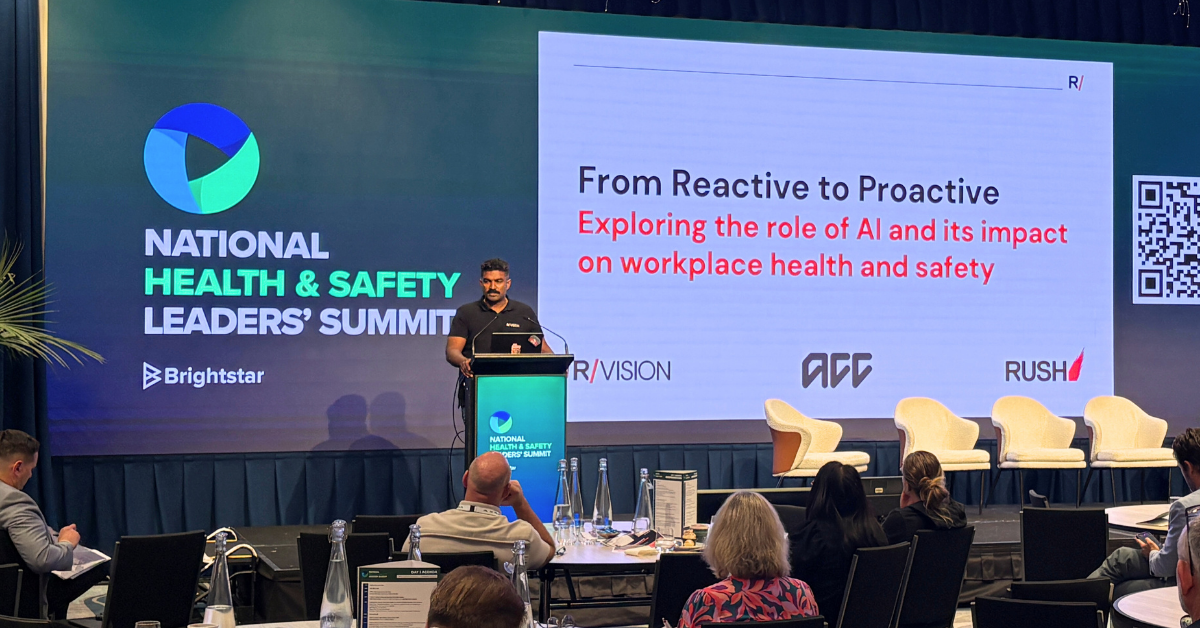

National Health & Safety Leaders Summit 2026
A recap of Danu Abeysuriya’s presentation at the National Health & Safety Leadership Summit, March 2026.
Exploring the role of AI and its impact on workplace health and safety
At the National Health & Safety Leaders Summit, Danu presented on the evolution and application of artificial intelligence (AI), specifically computer vision, in transforming workplace health and safety. The core theme was the shift from using "lag indicators" (analysing incidents after they occur) to "lead indicators" (proactively identifying risks in real-time).
The presentation detailed how modern computing power has made it possible to leverage existing CCTV infrastructure to monitor safety compliance, detect unsafe behaviors, and inform better workplace design, ultimately preventing incidents before they happen. He also highlighted RUSH’s partnership with ACC to study and promote the adoption of this technology across New Zealand.
Key Points
- The Evolution of Computing Power: The presentation began by contextualising the rise of AI. The speaker referenced Moore's Law (the exponential growth of computing power over the last 50 years) to explain why complex AI applications like real-time video analysis are only now becoming feasible and accessible. The computing power in a modern iPhone, for instance, is millions of times greater and more cost-effective than the computers used for the Apollo moon landing.
- Shifting from Lag to Lead Indicators: Traditionally, safety data comes from lag indicators like near-miss reports or incident investigations, which are reactive. RUSH's solution, R/VISION, uses AI to analyse camera feeds 24/7, providing real-time data on safety behaviors. This creates lead indicators, allowing for immediate intervention and a dramatic improvement in understanding and managing risk.
- How Computer Vision Works for Safety: The technology connects to existing CCTV streams to monitor and analyse workplace activity. It can:
- Measure the distance between people and moving plant equipment.
- Identify if workers are entering designated exclusion zones.
- Monitor for correct PPE usage.
- Track movement paths to identify high-risk areas and inform better traffic management and workplace layout.
- Detect ergonomic risks like overreaching or improper lifting techniques using the RULA scoring mechanism.
- Case Study: A successful implementation at a distribution centre demonstrated the technology's effectiveness. By analysing behaviors and providing visual feedback during toolbox talks, the site saw significant improvements:
- Aisle Occupancy Breaches: Reduced from 107 to 36 in a two-week trial.
- Exclusion Zone Adherence: Dramatically improved by using video examples to clarify rules for a high-turnover workforce.
- Proximity Adherence: Reduced unsafe interactions between pedestrians and forklifts, leading to a continuous improvement in safety performance over five months.
- ACC Partnership & Democratising Safety: RUSH is collaborating with ACC on a multi-year study to create a best-practice guide for implementing AI in workplace safety. The goal is to democratise the technology, making it accessible and affordable for all New Zealand businesses. The partnership aims to use the technology to inform good workplace design and reduce common injuries.
Action Points for the Audience
- Re-evaluate Your Existing Infrastructure: Consider your current CCTV cameras not just as tools for post-incident investigation, but as a rich, untapped source of real-time data for proactive safety management.
- Shift Focus to Leading Indicators: Move beyond relying solely on reactive incident and near-miss reports. Explore technologies like AI-powered computer vision to gain a 24/7, objective understanding of your site's safety compliance and risk profile.
- Use Visuals in Safety Training: Incorporate video examples (both positive and negative) into toolbox talks and training sessions. This transcends language and literacy barriers, making it easier for staff to understand and follow safety rules correctly. The case study showed most breaches were due to misunderstanding, not malicious intent.
- Emphasise Education Over Punishment: When implementing monitoring technology, frame it as an educational tool to help everyone stay safe, not as a disciplinary one. This fosters trust and encourages a positive safety culture.
- Engage with the ACC Programme: For those in the manufacturing space, consider partnering with our ACC innovation program to trial this technology. This provides an opportunity to improve your workplace safety with subsidised costs and contribute to developing a national best-practice guide.
Learn more
New Zealand businesses that are interested in the progress of the trials and developments in AI Health & Safety are encouraged to register for newsletter updates and project briefings: https://www.rvision.ai/intervention-project
RUSH Digital acknowledges the co-funding of this project by ACC's Workplace Injury Prevention programme.
Like the article? Spread the word


.png)

.png)
.png)